Every commercial truck needs a pre-trip inspection and a driver vehicle inspection report. For dump-truck operations, the paperwork usually lives on a clipboard in the cab — until a DOT officer asks for it at the roadside, or an auditor asks for six months of it at once.
When we built Carry Ops with Avensis Energy, an aggregator that runs a network of carriers, compliance came up from two directions. The office wanted proof that trucks were inspected before they rolled. The carriers wanted something simpler: a way to pull up a clean inspection record when a driver gets stopped. A good DVIR process gives you both.
Where paper DVIRs break down
- Every driver uses a different form. No two checklists look the same, so nobody can compare trucks.
- Defects get noted and forgotten. A driver writes "brakes soft" on a form that goes in a folder. The truck goes out again the next morning.
- Nothing stops a bad truck. A critical defect on paper doesn't prevent dispatch. Someone has to read it first.
- The record is hard to produce. At a roadside stop, the driver is digging through the cab. At audit time, the office is digging through boxes.
What a good pre-trip process looks like
- One checklist, on the driver's phone. Section by section — brakes and air, lights and signals, tires, trailer and securement — with big buttons a driver can use at 5 a.m. in under two minutes.
- Every fail carries evidence. A failed item needs a note, a photo and a severity. "Brakes soft" becomes a specific defect on a specific truck, with a picture.
- Critical fails lock dispatch. If the inspection finds a critical defect, the truck can't be dispatched until it's cleared. No human override, no "we'll fix it after this load."
- Repeat defects show up. The same issue on the same truck — or from the same driver — three weeks in a row should be visible without anyone building a report.
- The record is there at the roadside. The driver can pull up the inspection on their phone when an officer asks.
Whose trucks are you responsible for?
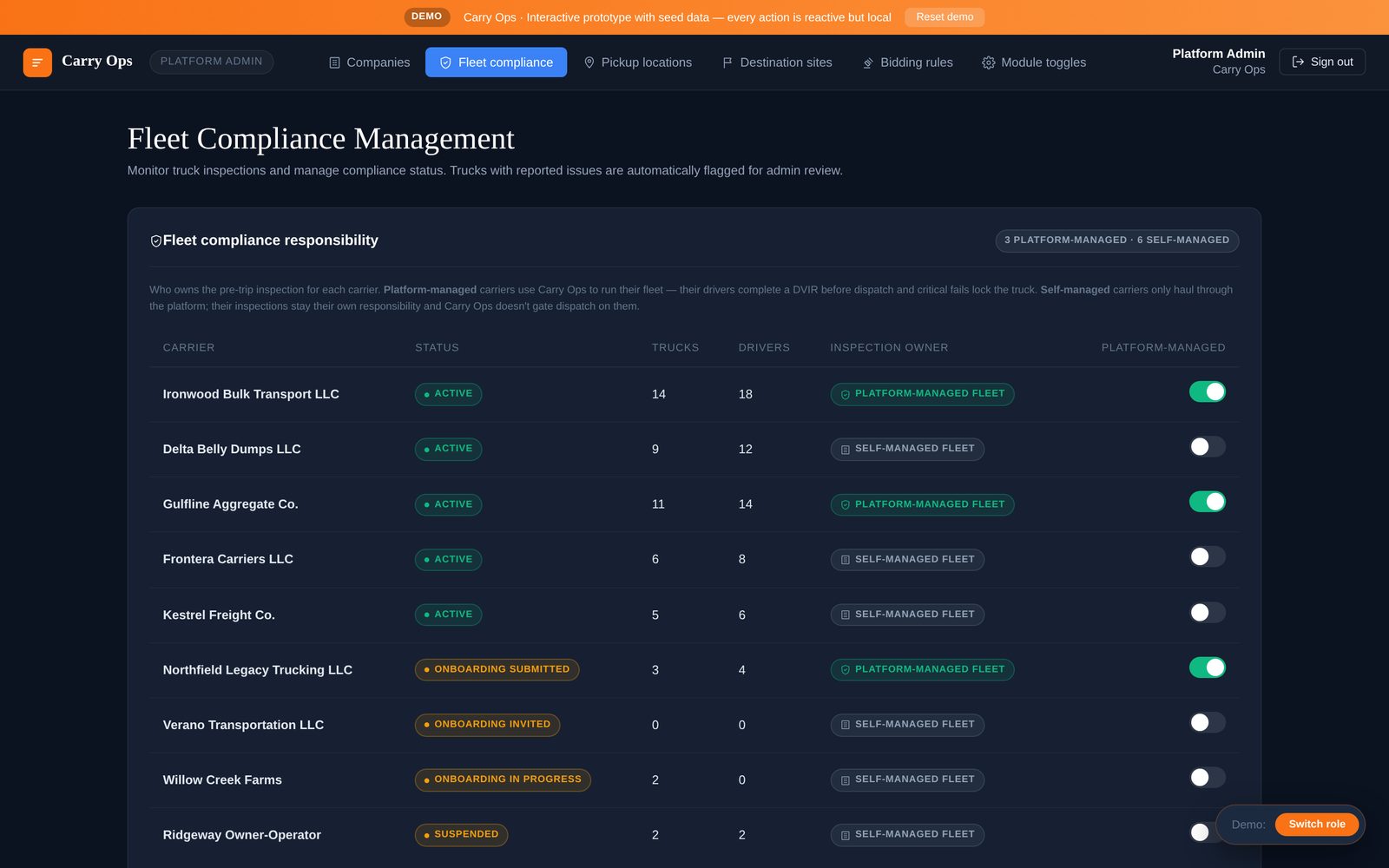
This is the question most compliance tools skip. On a typical job you have two kinds of trucks: the ones you or your carriers manage on your platform, and subhaulers who run their own maintenance programs. Forcing your inspection process on a carrier who already runs their own isn't your job — and it's a fast way to lose good subhaulers. The system should know which trucks it's responsible for and enforce inspections only there.
Driver records belong in the same place
Inspections are half of compliance. The other half is the driver: CDL, medical card, MVR, drug test, orientation. Expiring documents should flag themselves before the driver's next load, not after a stop turns up an expired medical card.
A quick check on your current process
Pick one truck and try to answer, in under five minutes: when was its last pre-trip, what defects were found in the last month, and were they fixed before it went out again? Then pick one driver and check when their medical card and CDL expire. If either answer means calling someone or digging through paper, you'll have the same problem at the roadside and at audit time.
The goal isn't more paperwork for drivers. A good mobile inspection is faster than the clipboard, and it protects the driver too: when they're stopped, a clean, timestamped record with photos is the quickest way back on the road.
How this works in Carry Ops
Compliance Guard in Carry Ops runs the pre-trip on the driver's phone, section by section. Every failed item needs a note, a photo and a severity, and a critical fail locks dispatch for that truck until it's cleared. Admins see inspection status and open issues for every truck in one place, with each carrier marked as platform-managed or self-managed, so inspections are enforced only where Carry Ops manages the fleet. Drivers can pull up their inspection record at a roadside DOT stop, and driver documents — CDL, medical, MVR, drug test — are tracked with expiration alerts.