Hiring drivers for belly dumps and end dumps is a numbers game nobody enjoys. Applications come in from everywhere, plenty of candidates never pick up the phone, and someone in the office spends an afternoon on an application that was never going to clear the drug test or the MVR.
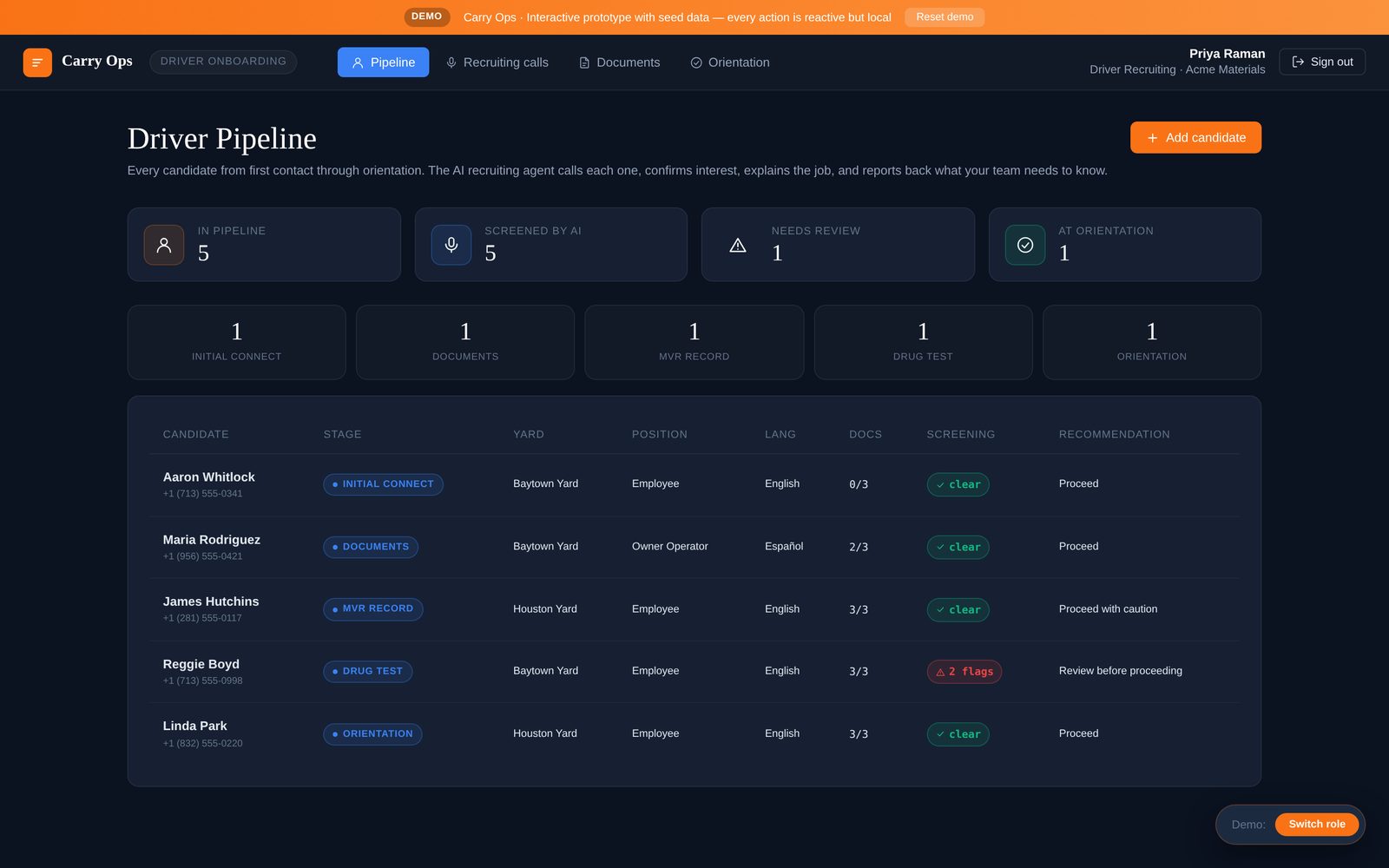
When we built Carry Ops with Avensis Energy, a Houston-area aggregator that's stepping up and using technology to smooth out its operations, driver recruiting was one of the jobs they wanted taken off the office's plate. Not the decision to hire — that stays with people — but everything that happens before a person should spend time on a candidate.
Where recruiting time actually goes
- Chasing first contact. Calling candidates who applied last week to find out if they're still interested.
- Explaining the same job twice a day. Yard, equipment, hours, pay structure, owner-operator or employee.
- Finding the deal-breakers late. The candidate who won't work weekends, needs lodging for two weeks, or has never driven a belly dump — discovered after the paperwork is done.
- Chasing documents. CDL, medical card, the missing page, the drug test they haven't scheduled.
- Getting them to orientation. Reminders, rescheduling, no-shows.
Screen with a phone call, not a form
The most useful part of a driver's application is the conversation, and it's the part most hiring processes skip until late. An outbound screening call that confirms interest, explains the job and asks the right questions up front surfaces the things your team needs to know first:
- Availability — weekends, early starts, standing commitments.
- Experience — years on belly dumps or end dumps, the kind of material, familiarity with the lane.
- Logistics — how far they live from the yard, whether they need lodging, whether they bring their own tractor.
- Risk flags — anything the team should look at before going further.
Do this in English and Spanish. At least 23.7% of the US truck-driver workforce is Hispanic; a screening process that only works in English loses good drivers on the first call.
One pipeline from first contact to orientation
Once a candidate is worth pursuing, every step should live on one record instead of across email, texts and a spreadsheet:
- Initial contact — interest confirmed, job explained, highlights written up.
- Documents — CDL, medical card and the rest, with reminders for what's missing.
- MVR — requested and reviewed.
- Drug test — scheduled, with a deadline and a reminder.
- Orientation — date, yard, and a reminder call the day before.
At any moment, the team should be able to see how many candidates sit at each stage, who needs a human look, and who's ready for orientation.
Keep people on the decisions
An AI recruiting call is a filter and a note-taker, not a hiring manager. It should recommend — proceed, proceed with caution, review before proceeding — and leave the call to your team. The value is that by the time a person opens a candidate's file, the basic questions are already answered.
A quick check on your current process
Look at last month's applicants. How many did nobody ever reach? How many made it through documents before a deal-breaker came up? How many no-showed at orientation? Those three numbers tell you where the hours are going.
How this works in Carry Ops
Driver Onboarding in Carry Ops runs one pipeline from first contact through orientation. An AI recruiting agent calls each candidate, confirms interest, explains the job and writes up highlights — availability, experience, logistics, compensation questions and risk flags — with a recommendation for your team. Documents, MVR, drug test and orientation are tracked per candidate, reminders go out by text and call, and everything runs in English or Spanish. Your team decides who gets hired; the platform makes sure they're only spending time on candidates worth it.