In bulk hauling, almost everyone waits to get paid for the same reason: the ticket. The customer won't pay without backup, the aggregator or contractor can't invoice without the signed ticket, and the carrier who hauled the load waits at the end of the line — sometimes for weeks, sometimes forever.
When we built Carry Ops with Avensis Energy, a Houston-area aggregator, one of the first things we noticed was how much of their week went to chasing paper so that money could move. Getting paid faster wasn't a finance problem. It was a visibility problem.
Where the days go
Follow one load from pit to payment and count the waiting:
- The ticket rides in the cab. Days until the driver turns it in — if they do.
- The office re-keys it. More days to type the slips into billing and match them to loads.
- The invoice waits for the stack. One missing ticket can hold an entire invoice.
- The customer asks for backup. Weeks, if a weight is questioned and nobody can find the original.
- The carrier waits for all of the above. And if their ticket was the one that went missing, they may never get paid for that load.
Everyone tracking the same load
Most of those delays come from the same root cause: once the truck leaves the pit, nobody can see the load. The customer calls the office, the office calls dispatch, dispatch calls the driver. When every party can see the same load — picked up, in transit, delivered, signed — the questions stop and the paperwork isn't the only proof anymore.
Invoice from delivered tickets, not from the stack
The fastest billing setups don't start invoicing at month-end. They build the billing package as loads are delivered:
- Every signed ticket becomes a line on the invoice automatically, with the PDF attached as backup.
- Loads outside the weight tolerance are flagged before billing, so you aren't invoicing a load you'll have to credit later.
- The customer can pull the same tickets themselves, which removes most "send me the backup" delays.
- AR reminders and days-to-pay tracking show who's slow before it becomes a cash problem.
Faster pay is a carrier benefit, too
Carriers often see e-ticketing as one more thing a customer is making them do. Flip it: unsubmitted tickets are the main reason carriers get paid late. A ticket that lives on a text link can't blow out of the cab or get lost in a folder. Every load they hauled is on the record, signed at the site — so they get paid for all of it.
Measure your days-to-cash
Pick ten loads delivered last month and track three dates for each: delivered, invoiced, paid. The gap between delivered and invoiced is your ticket problem. The gap between invoiced and paid is mostly a backup and dispute problem. And if you also know when your carriers were paid for those loads, you'll see exactly how long they're waiting on you.
Most operations are surprised by the first gap. It's the one that's entirely in your control — and the one that disappears when the signed ticket turns into an invoice line the day the load is delivered.
How this works in Carry Ops
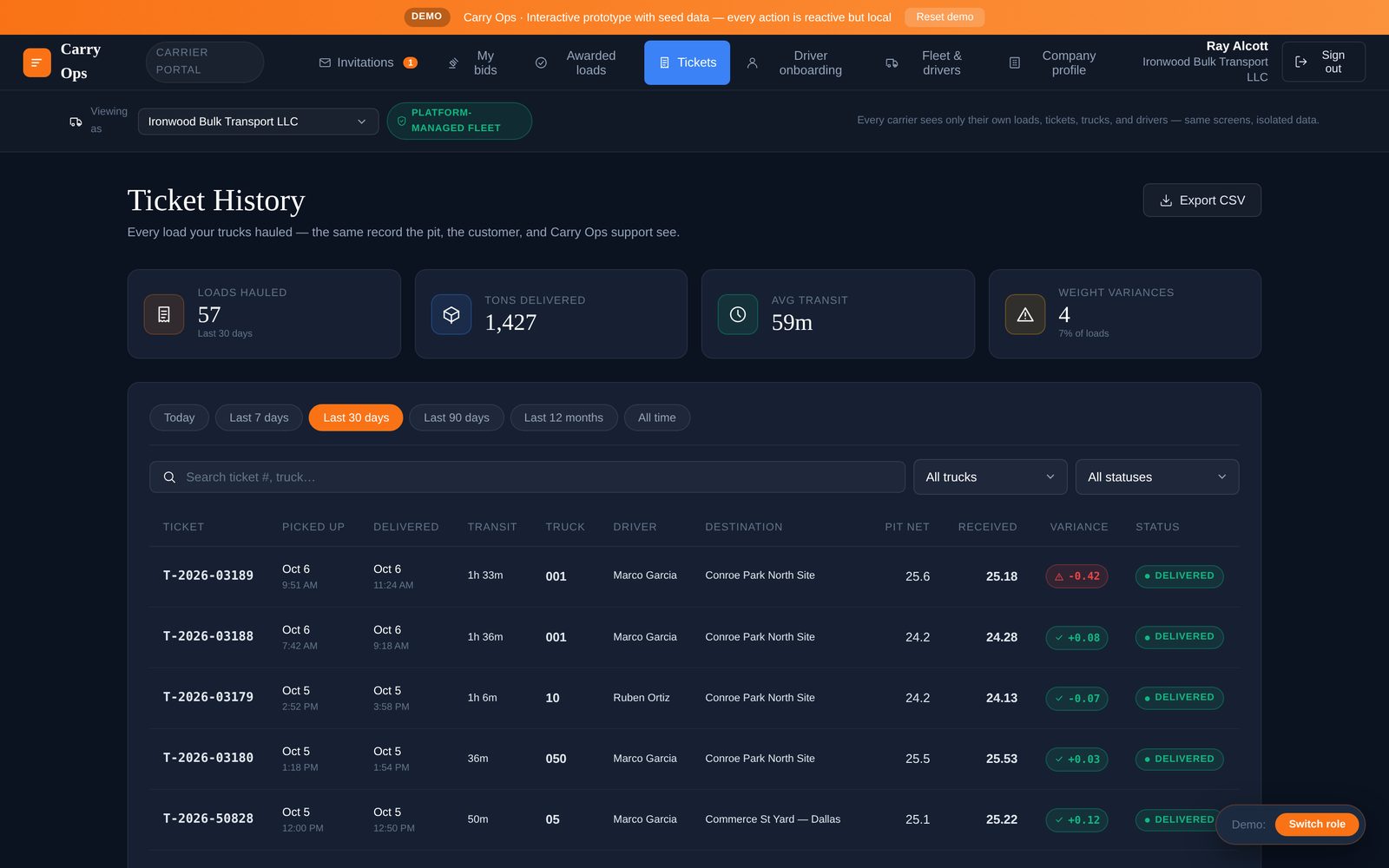
In Carry Ops, the pit's ticket goes by magic link to the driver and the destination, so the aggregator, the contractor, the carrier and the customer all see the same load as it moves. Signed delivery tickets roll straight into a billing package with the PDFs attached, so the invoice goes out when the load is delivered instead of when the last slip turns up. CashFlow Accelerator adds AR reminders, days-to-pay tracking and an optional bank tie-in to move the deposit faster. Carriers see their full ticket history in their own portal — the same record the customer sees.