At the end of the month, someone sits down with a stack of scale tickets and an invoice and tries to make them agree. The pit says one weight. The site's scale says another. A handful of tickets are missing. And three weeks after delivery, the customer disputes a load nobody remembers clearly.
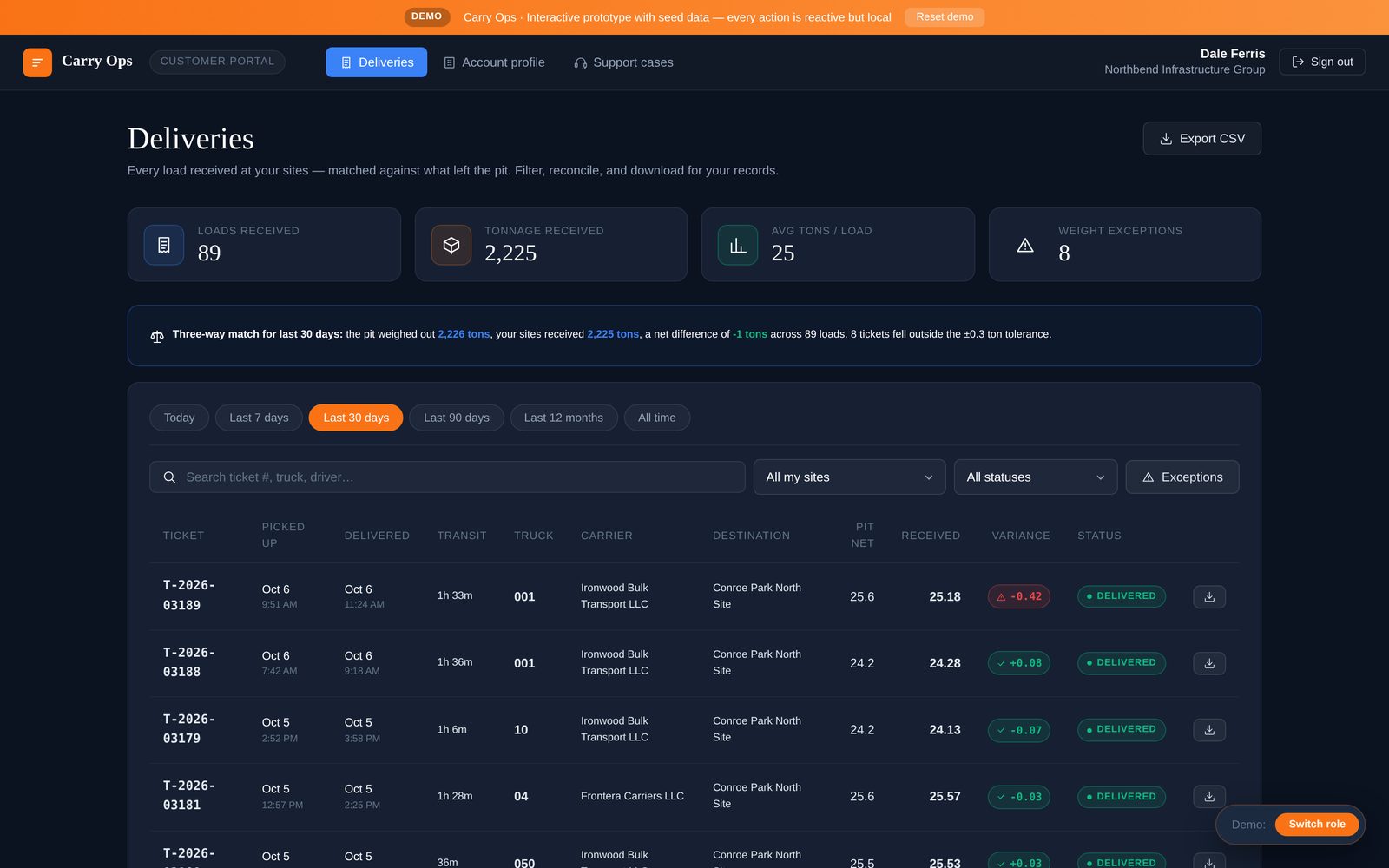
Reconciliation is where all the earlier problems in a hauling operation come home. When we built Carry Ops with Avensis Energy, a Houston-area aggregator, cleaning up month-end was one of the first things the office asked for — because by the time a load reaches reconciliation, every mistake upstream has already turned into a dispute.
Why pit weight and received weight disagree
Some difference is normal. Two scales, two calibrations, a little material lost on the road. The trouble starts with how paper handles it:
- Three copies, no single record. The pit, the site and the driver each have their own slip. When the numbers differ, there's no agreed answer — just whose paper is more convincing.
- One number overwrites the other. Someone "corrects" the ticket to match the site's reading, and the original pit weight is gone.
- Nobody notices until it's billed. The difference sits unnoticed until the customer sees the invoice. By then the driver doesn't remember and the conversation is about who blinks first.
Keep both weights. Always.
The single most useful rule we built in: never let one weight overwrite the other. The pit's net weight is the legal weight captured at the scale. The received weight is what the site measured. Both belong on the same ticket, side by side, forever. Then the difference is a fact you can see, not an argument about which number is real.
Set a tolerance and flag at the gate
Decide what difference is normal for your material and scales, then flag anything outside it the moment the load is received — not at month-end. In Carry Ops the default is plus or minus 0.3 tons. A load inside the tolerance is done. A load outside it gets looked at the same day, while the driver, the attendant and the photos are all still fresh.
Give the customer the same view you have
A lot of disputes are really requests for backup. The customer wants to see the tickets for the period, both weights, and which loads were off. If they have to email you and wait, the dispute grows. If they can pull it themselves — filter by day, week, month, quarter or year, see the three-way match and download any ticket — most questions answer themselves.
When there is a dispute, raise it on the ticket
The last piece is where disputes live. An email thread about "the load on the 14th" is how evidence gets lost. A case raised against a specific ticket — with both weights, timestamps, signatures and the resolution attached — is something anyone can read later, including an auditor.
Audits get easier for free
When every ticket carries both weights, timestamps and signatures, and every inspection is on file, the audit pack is a filter and an export instead of a week of digging through boxes and inboxes.
A simple month-end test
Take last month's invoice for one customer and try to answer three questions without opening a filing cabinet: how many tons did the pit ship to them, how many did their sites receive, and which loads differed by more than your tolerance? If you can't answer in a few minutes, reconciliation is still a manual job in your operation — and every manual step is a place for a dispute to start.
How this works in Carry Ops
Every Carry Ops ticket keeps two weights: what left the pit and what the site received. Neither ever overwrites the other, and any load off by more than 0.3 tons is flagged as it arrives. Receiving customers get their own portal to filter deliveries, see the three-way match for any period, and download a ticket or the whole range as a CSV. Disputes are raised against the ticket itself, and support works them from the same record — all three legs of the haul on one screen.